
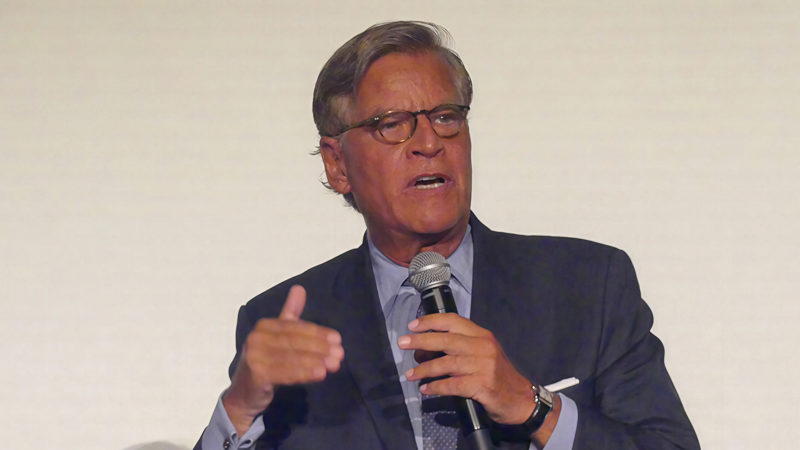
Aaron Sorkin joined Mikey Madison and Jeremy Allen White in Paris for a post-screening Q&A about his return to Facebook 16 years after The Social Network.
Paris welcomed Aaron Sorkin, Mikey Madison, and Jeremy Allen White on October 1 for the French premiere of The Social Reckoning at the Pathé Palace, just days before the film begins its theatrical rollout. After the screening, the three joined an approximately 28-minute Q&A moderated by Arthur Cios, giving the Paris audience a chance to hear directly from the filmmaker and the two actors at the center of Sorkin's return to the world of Facebook.
The evening carried particular significance because The Social Reckoning arrives 16 years after The Social Network, the David Fincher film that earned Sorkin the Academy Award for Best Adapted Screenplay. This time, Sorkin is not only the screenwriter but also the director, approaching Facebook from a radically different point in its history.
Sony Pictures describes The Social Reckoning as a companion piece to The Social Network rather than a conventional sequel. Where the earlier film dramatized Facebook's creation and the personalities surrounding its rise, the new story looks at what happened after the platform became one of the most powerful forces in modern communication.
At the heart of the film are Frances Haugen and Jeff Horwitz, played by Madison and White. Inspired by the true events behind the Facebook Files, the story follows Facebook engineer Haugen as she enlists Horwitz, a reporter for The Wall Street Journal, and begins revealing some of the company's most closely guarded internal information.
Their relationship becomes the dramatic engine of Sorkin's thriller, placing journalism, whistleblowing, and personal trust against the institutional power of Facebook. Frances and Jeff begin from very different positions, but the investigation gradually forces both of them beyond their comfort zones as the risks surrounding the information become increasingly clear.
Madison's presence in Paris was particularly notable following her Academy Award-winning performance in Anora. Frances presents a very different challenge: an introverted, analytical engineer whose conflict comes partly from her continuing belief in what Facebook could have been.
Madison approached the role without attempting to physically imitate Haugen. In discussing her preparation for the film, she has explained that the transformation was more intellectual than physical, focusing on Frances' emotional restraint, analytical thinking, and moral conviction. Sorkin likewise did not want a physical impersonation, preferring Madison to interpret the character as written.

That approach gives Madison a character whose courage is not built around conventional heroics. Frances does not necessarily view herself as a heroic figure. Her decision grows from the realization that she can no longer remain silent about information she believes the public needs to understand.
White brings a complementary perspective to Horwitz. Rather than presenting him as a technology expert, the story emphasizes his position as an investigative journalist entering a world whose language and systems he does not completely understand. That gap becomes part of his relationship with Frances, who initially has reason to question whether he fully understands what she is trying to reveal.
As they move deeper into the investigation, their uneasy working relationship becomes increasingly personal. Horwitz begins to understand not only the significance of the documents but also the risks he is asking his source to take. The film consequently treats journalism as more than a mechanism for delivering information, making the trust between reporter and source central to the story.
The Paris premiere also placed Sorkin himself at the center of the evening, bringing him back before an audience with a subject he has followed for more than a decade. His inspiration for the new film developed as he researched Haugen's disclosures and Horwitz's reporting, eventually leading him back into the world he first dramatized in The Social Network.
The difference is one of perspective. The Social Network arrived when Facebook was still associated with rapid growth, disruption, and the personalities behind a new kind of technology company. The Social Reckoning comes from a later vantage point, when the questions surrounding social media involve algorithms, political division, misinformation, mental health, and the enormous influence technology companies can exercise over public life.
Sorkin nevertheless approached the project as a dramatic feature rather than a documentary reconstruction. The film is inspired by real events, but its purpose is to turn those events into a character-driven story about the people involved in bringing the Facebook Files to the public.
Beyond the trio present at Pathé Palace, The Social Reckoning features Jeremy Strong as Mark Zuckerberg, taking over the role played by Jesse Eisenberg in The Social Network. The ensemble also includes Wunmi Mosaku, Betty Gilpin, Billy Magnussen, and Bill Burr.
Behind the camera, Sorkin reunites with cinematographer Jeff Cronenweth, whose work provides a visual connection to The Social Network while allowing the new film to establish an identity of its own. Alan Baumgarten edited the feature, with an original score by Alexandre Desplat. The film runs 112 minutes.
The October 1 event at the Pathé Palace provided a fitting Paris introduction to a film built around consequences. Bringing together Sorkin, Madison, and White made the premiere more than a traditional promotional appearance: the writer who first dramatized Facebook's beginnings stood alongside the actors portraying the whistleblower and journalist through whom he now examines a later chapter in its history.
Sixteen years after The Social Network, Sorkin has returned to Facebook with a fundamentally different question. The story is no longer about how a social network was created. It is about what happened after that network grew powerful enough to reshape the world around it, and what it takes for the people inside that system to finally speak out.
The Social Reckoning opens exclusively in U.S. theaters October 9, 2026.
ABOUT THE AUTHOR