Inside Paris' Musée Rodin, original Hunger Games costumes and new designs from Sunrise on the Reaping reveal how fashion, spectacle, and power define Panem.
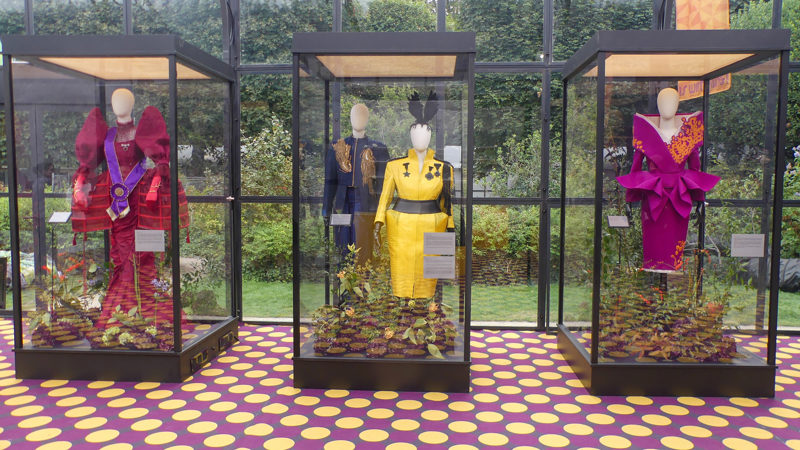
Paris may have just wrapped another Fashion Week, but one final collection has arrived from a rather more dangerous capital. On October 7 and 8, 2026, the sculpture garden of the Musée Rodin becomes a temporary gateway to Panem with Elegance Is Authority: The Story, Style and Power of Panem, an installation celebrating The Hunger Games' distinctive visual universe. Bringing together original costumes from the franchise and new pieces created for the upcoming The Hunger Games: Sunrise on the Reaping, the event gives visitors a rare chance to examine designs up close that sometimes appear on screen for only seconds. Fabrics, embroidery, silhouettes, accessories, and carefully constructed details reveal just how much of Panem's identity has always been communicated through costume.
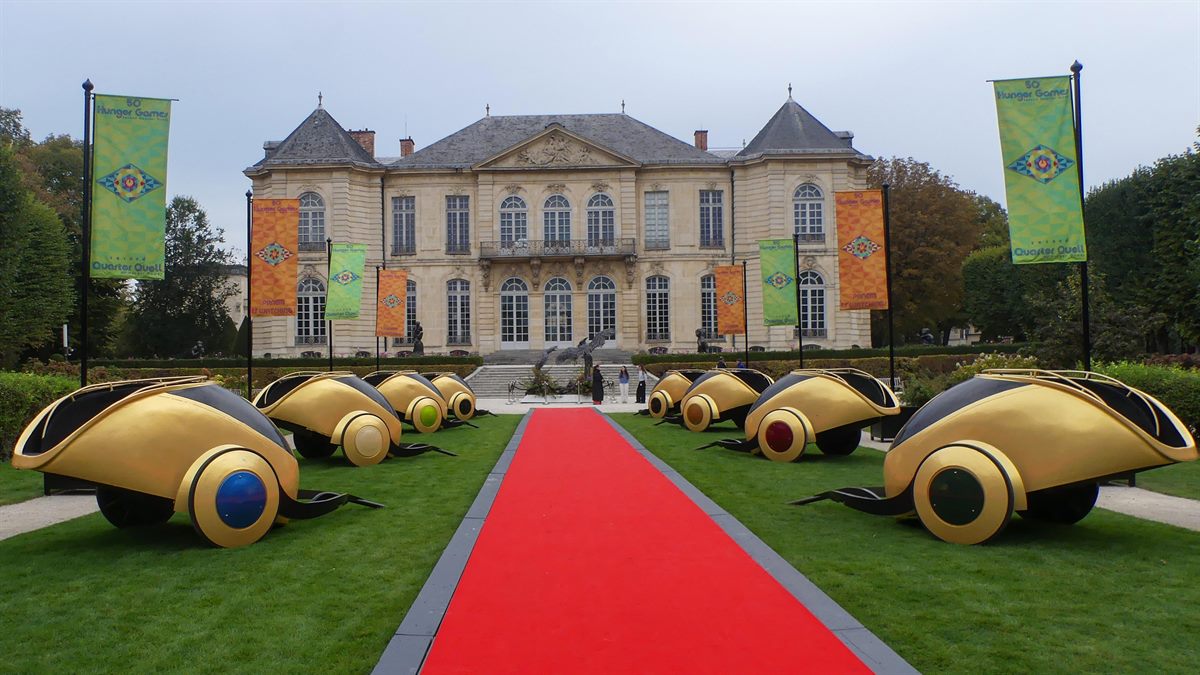
Rather than functioning simply as a collection of memorable movie outfits, Elegance Is Authority explores the relationship between fashion and power that has existed throughout The Hunger Games. Clothing identifies social position, district, political allegiance, and rebellion, while the Capitol uses appearance as part of the machinery that transforms violence into entertainment. In the sculpture garden of the Hôtel Biron, golden chariots, bronze animal imagery, banners celebrating the 50th Hunger Games, and stacks of old television sets broadcasting Capitol-inspired propaganda transform the elegant Parisian surroundings into an extension of Panem. Familiar designs from the previous films are displayed alongside costumes from the new movie, creating a visual connection between the franchise audiences already know and the chapter that is about to begin.
The contrast between District 12 and the Capitol has always been particularly important to the visual identity of the series. The districts are associated with practicality, labor, and survival, while the Capitol answers with artificiality, extravagance, and theatrical excess. Familiar imagery connected to Katniss Everdeen and the flamboyant style associated with Effie Trinket demonstrate how costume can establish a character before a single word is spoken. Seen outside the rapid movement of a film, these pieces also reveal the physical craftsmanship behind them. Textures, layering, proportions, ornamentation, and construction become much more visible, allowing the costumes to be appreciated both as cinematic objects and as essential elements of storytelling.
The exhibition arrives only weeks before the release of The Hunger Games: Sunrise on the Reaping, the sixth movie in the franchise. Directed by Francis Lawrence and based on the 2025 novel by Suzanne Collins, the film takes audiences back 24 years before the events of the original The Hunger Games. Its story revolves around the 50th Hunger Games, better known as the Second Quarter Quell, an anniversary edition in which the Capitol doubles the number of tributes. Instead of the traditional 24 competitors, 48 young people are selected, forcing every district to send four tributes into the arena.
At the center of the story is 16-year-old Haymitch Abernathy, played by Joseph Zada. Audiences already know the man Haymitch eventually becomes through Woody Harrelson's performance in the original films, where he served as the brilliant but deeply damaged mentor to Katniss Everdeen and Peeta Mellark. Sunrise on the Reaping instead introduces him as a teenager whose primary concern is remaining with the girl he loves before the Quarter Quell violently changes the course of his life. Knowing what awaits the character adds another dimension to the story: Haymitch may survive the Games, but the earlier films have already shown audiences the enormous personal cost of that survival.
The film also introduces younger incarnations of several characters who became central figures in the previous movies. Jesse Plemons portrays Plutarch Heavensbee, Elle Fanning becomes Effie Trinket, Kieran Culkin takes on Caesar Flickerman, and Ralph Fiennes plays President Coriolanus Snow. Glenn Close appears as District 12 chaperone Drusilla Sickle, while Mckenna Grace portrays twin sisters Maysilee and Merrilee Donner. The ensemble also includes Maya Hawke, Whitney Peak, Kelvin Harrison Jr., Lili Taylor, Billy Porter, and Ben Wang. With Francis Lawrence once again behind the camera, the film returns directly to the structure and rituals of the Hunger Games while approaching familiar elements of Panem from a different generation and historical moment.
That makes the focus of the Paris exhibition particularly relevant. Before the tributes ever enter an arena, the Capitol transforms them into public figures. Their appearances, interviews, costumes, and televised personas become part of an enormous entertainment machine designed to make the Games compelling to an audience. Fashion is therefore never merely decorative in this universe. It participates directly in the construction of celebrity, hierarchy, and political control. The costumes displayed at the Musée Rodin provide a physical reminder of how thoroughly this visual language has been integrated into the storytelling of the franchise.
The public installation was preceded on October 6 by a special gala at the Musée Rodin attended by Joseph Zada and Mckenna Grace. Grace's appearance created one of the evening's most visible connections between the original films and Sunrise on the Reaping. Her gown referenced the memorable wedding-dress imagery associated with Katniss Everdeen in The Hunger Games: Catching Fire, turning the red carpet itself into another extension of the franchise's visual history. It was an especially appropriate choice for an event centered on the idea that clothing in Panem can communicate identity, expectation, and political meaning before a character has even spoken.
The timing immediately after Paris Fashion Week adds another dimension to the installation. For a brief moment, the exaggerated couture of the Capitol exists alongside one of the world's real fashion capitals, allowing the exhibition to operate simultaneously as movie promotion, costume showcase, and fashion event. The concept feels particularly appropriate for The Hunger Games, where presentation has always been inseparable from power. The Capitol understands that appearance can influence how people perceive both individuals and events, turning tributes into celebrities and suffering into spectacle.
The return of Panem is also being accompanied by an ambitious musical campaign. On October 2, Noah Kahan released "Draw You Out," the lead single from The Hunger Games: Sunrise on the Reaping (The Album), co-written and co-produced with Aaron Dessner. The 29-track soundtrack is executive-produced by Dave Cobb, with its release scheduled for November 13, one week before the movie's U.S. theatrical debut on November 20. Composer James Newton Howard also returns to score the film, continuing one of the strongest musical connections between the different chapters of the franchise.
Together with the trailers, Capitol-inspired promotional material, and the Paris installation, the campaign once again presents Panem as something larger than a simple movie setting. It is a complete media environment constructed through fashion, television, music, propaganda, and performance. That strategy mirrors the fictional Capitol itself, where entertainment and political messaging constantly overlap and where every image appears designed to influence an audience.

There is also something particularly effective about placing the aggressively manufactured glamour of Panem inside the sculpture garden of the Musée Rodin. The surroundings naturally encourage visitors to stop and examine objects, while the Capitol-inspired staging prevents the costumes from becoming disconnected museum pieces. Instead, they retain their narrative function. Designs that normally exist within rapidly edited sequences can be studied for their materials, proportions, and construction, revealing details that contribute to the credibility of Panem long before visual effects, music, and editing complete the cinematic illusion.
For longtime fans, much of the immediate pleasure comes from recognizing familiar silhouettes while discovering the designs that will define Sunrise on the Reaping. For anyone interested in costume design, production design, or filmmaking, however, the exhibition offers another perspective on how physical craftsmanship contributes to world-building. Every texture, color, and exaggerated shape helps establish where a character belongs, how the Capitol wants that character to be perceived, and what kind of story is being manufactured around them.
Elegance Is Authority reinforces one of the central ideas that has run through The Hunger Games since the beginning: power is not simply exercised in Panem; it is staged. The Capitol understands that domination becomes easier to accept when it is wrapped in glamour and that violence becomes easier to consume when presented as entertainment. Katniss and the rebellion eventually learn how to appropriate that same visual language and turn it against those who created it. The costumes may be beautiful, extravagant, and spectacular, but their significance extends far beyond fashion. In Panem, appearance is part of the political system itself, and elegance truly is authority.
ABOUT THE AUTHOR