
FlickVision Interview
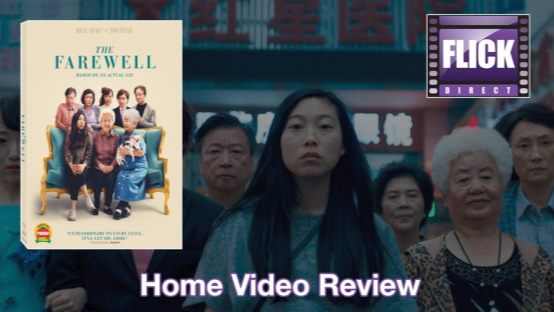
The Farewell Director Lulu Wang Sits Down With FlickDirect

Interview chapters
- 00:00:00 — The Farewell: A Love Letter to Family and Culture
- 00:00:33 — Cultural Differences and Perspectives
- 00:01:19 — Symbolism in the Movie
- 00:02:01 — Symbolism of the Rainbow and the Bird
- 00:02:46 — Interpreting Signs and Symbols
- 00:03:27 — Awkwafina's Audition Tape
- 00:04:13 — Billie as a Conduit for Immigrant Kids
- 00:05:06 — The Importance of Realistic Storytelling
- 00:05:37 — The Value of Being a Normal Person
Read transcript
Hi, I'm Allison with FlickDirect and I am here with Lulu Wong to talk about her new film The Farewell. Hi, how are you? I'm good, how are you? I'm good, thank you. I feel like this film is a love letter to family and culture. Do you feel that sense with the film? Yes, absolutely. It was definitely a tribute to my family, especially to my grandmother.
Yeah, I will have to say it made me miss my grandmother terribly. But I love that whole sense of family. I have that with myself and I think a lot of people can relate to it because even if they don't come from an Asian background, I think a lot of families still have that kind of cultural aspect to it. Yeah, absolutely. I always say that this is a film about a difference of cultures and difference of perspectives, but that culture isn't just about East versus West, Asian versus American.
Culture also applies when your family is from Texas but you moved to New York City or Miami, right? Or your family is conservative but you're a liberal. That's a totally different culture. So I think that it really applies. It's just really about different perspectives. When you love somebody and you've grown up in the same family, but you ultimately have different paths in the way you view the world.
Yes, absolutely. Talk to me a little bit about the symbolism in this movie. I felt, maybe I'm reading into it, but I felt the archway was kind of symbolic and I specifically would like you to speak about the bird. Yeah, oh gosh. No one's asked me about that rainbow arch yet. I love that rainbow because it's always under construction. I think Boston people can relate to that because they had the big dig that was forever took to build.
I mean, and that sort of sums up China for me so much is that there's this beautiful rainbow in the center of the city that's supposed to represent all of the magical things that rainbows represent, but it's always under construction. And that's China. The dream is always under construction. So yeah, so that's why that rainbow was very symbolic for me to see sort of both the symbol of beauty, but also the way that it's, you know, never quite finished, never quite finished in development.
Yeah. And, and the bird, the bird, you know, I think for me, the bird is this idea of like perspective, right? Because birds carry a lot of symbolism in different cultures and they have different meanings for different people. And so having the bird appear twice, you know, for people who believe in signs, they might see that as a sign. Yes, absolutely.
And people who are optimistic, they might see that as an optimistic sign. People who are negative might see it as a bad omen. And for people who really don't believe in that stuff, they'll just say, Oh, it's a bird, you know, and so it wasn't my intention to say this is what it means, but I wanted to put it in the film because sometimes in life, there are these little signs that are dropped and depending on who's looking at them, they'll either see meaning in it or they won't.
Well I will say that I did notice it and I questioned it in my mind of the symbolism of it. So I think it worked well in the film. I want to talk about Awkwafina because to me, she's this comedic actress, but she was so wonderful. Were you at all concerned of how she could take on such a serious role? Yeah, I mean, actually when my producer first mentioned her name, I was very familiar with her work, but more in her music, her, you know, music videos.
And so I was like, that girl who did my vag, that's who, that's who you think should play some version of me in a dramatic film? Like I don't understand. But you know, of course I met with Awkwafina, we sat down and she talked about how much she resonated with the film because she was raised by her own Chinese grandmother. And she said, you know, but you're probably wondering if I can act.
I don't know, you know, I'll do a tape, I'll send it to you, you can see for yourself. So she sent in this audition tape and as soon as I saw it, I knew she was Billie. And not because she was some version of me, but because she just had, you know, Billie is a conduit for the audience and for, you know, all the immigrant kids who have ever felt in between two cultures and two worlds.
And she just had all of those expressions, even without talking, you could see the way that she was processing all of these conflicting emotions. What does it mean for you to have such a personal film get such critical appraisal? Gosh, you know, it's really unexpected and just really validating, you know, because my father, when he first read the script, because I wanted to ask him, you know, if he felt it was true to the experience and to our family and that I was doing justice to everyone.
And so he read the script and he said, yeah, but you know, it's very authentic. But why is this important? You know, or why is this? Why does anybody want to see this? Why is it interesting? You know, he's used to seeing like, you know, action movies and Star Wars and superhero movies. So he thought, you know, that I would at least exaggerate and create some more drama to put into it.
And when he saw that I didn't, he just was really nervous. He thought, you know, what if nobody cares and nobody wants to see this, these mundane things in our in our lives. And the same with my great aunt who plays herself in the movie. Yes, I know that. Yeah. So she thought, you know, I'm just a normal person. She said, I am not a movie star. I don't want to ruin your movie.
You can't cast me in this movie. So for them, for my family to see the film, get this kind of response. It just warms my heart because it, you know, it's, it was my way to show them that their lives have value, that being a normal person is, you know, is, is, is matters, matters that you are, you know, your stories and your faces are worthy of the big screen and worthy of sharing with the world.
Well, I loved it. And you can prove, tell your father proved him wrong. And thank you so much for talking with us today. Thank you. [Music] [BLANK_AUDIO]
More Interviews

ABOUT THE INTERVIEWER

ABOUT THE FAREWELL
In this funny, uplifting tale based on an actual lie, Chinese-born, U.S.-raised Billi (Awkwafina) reluctantly returns to Changchun to find that, although the whole family knows their beloved matriarch, Nai-Nai (grandma), has been given mere weeks to live, everyone has decided not to tell Nai Nai herself. To assure her happiness, they gather under the joyful guise of an expedited wedding, uniting family members scattered among new homes abroad. As Billi navigates a minefield of family expectations and proprieties, she finds there’s a lot to celebrate: a chance to rediscover the country she left as a child, her grandmother’s wondrous spirit, and the ties that keep on binding even when so much goes unspoken. With The Farewell, writer/director Lulu Wang has created a heartfelt celebration of both the way we perform family and the way we live it.Directed By: Lulu Wang
MPAA Rating: PG
Genre: Comedy, Drama
Running Time: 98 minutes
Distributed By: A24


The Farewell is © A24. All Rights Reserved.