
FlickVision Interview
Those Who Remained Explores Common Themes | A Talk with Director Barnabás Tóth
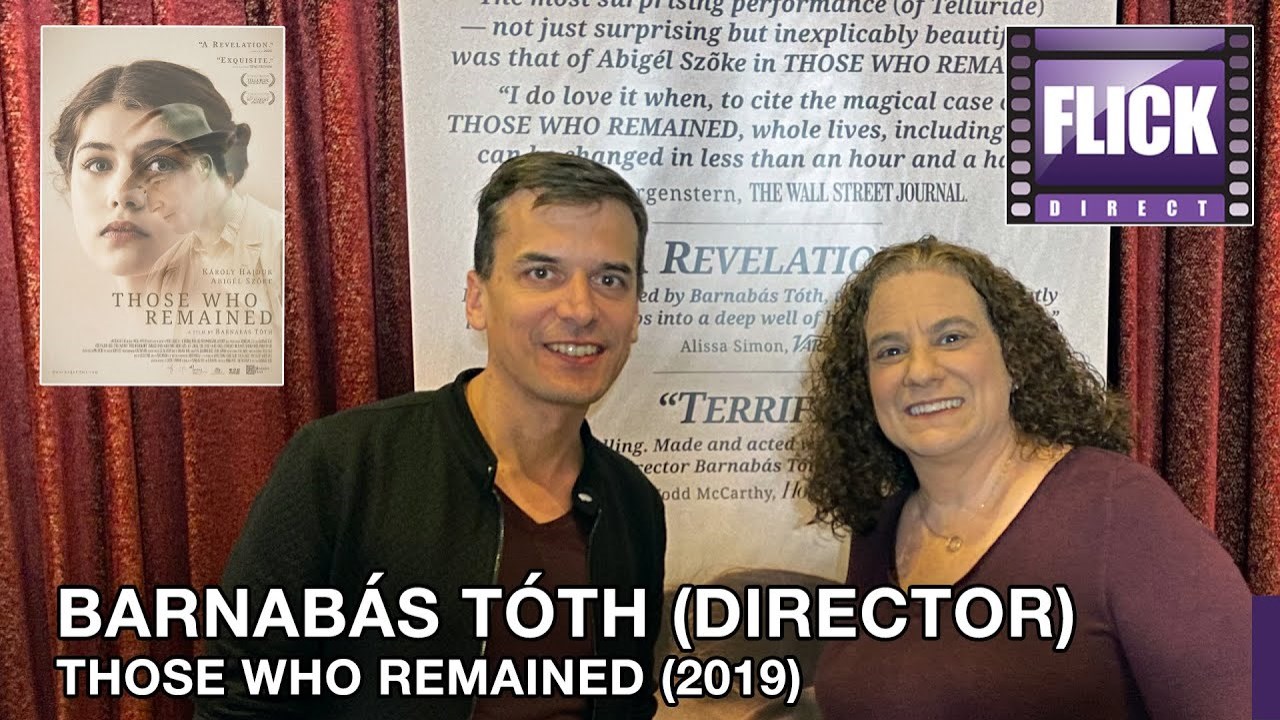
Director Barnabás Tóth spoke with FlickDirect Correspondent Allison Rose about his compelling film, Those who Remained, and the common emotions survivors share.
Interview chapters
- 00:00:00 — Interview with Javier Gutiérrez, director of the movie
- 00:00:31 — The opportunity to do something in the horror genre
- 00:00:56 — Technology and morality in our society
- 00:01:23 — Exploring the psychology of the characters
- 00:01:45 — The right path
- 00:02:13 — The intention of the movie
- 00:02:41 — Expansion of technologies
- 00:03:04 — A journey through suspense and psychology
- 00:03:36 — Fun but terrifying
- 00:03:54 — The story and media twists
Read transcript
Hey, I'm Allison with FlickDirect and I'm here talking to Barnabas Toth about Those Who Remained. Hello, how are you? Hello, I'm fine, thanks. So, you co-wrote this film along with directing it. What was the inspiration behind it? The inspiration came from a novel. It's an adaptation. Oh! And I discovered that book maybe five, six years ago. And I knew the author before because I worked with her in a theater project.
Oh, okay. She's a psychotherapist. That's her only fictional book. Oh! So I found that so rich material, the characters and the dialogue. And it's so perspective on the Holocaust but through the eyes of people who came back, you know. Yes. And how to heal from this trauma. So I found it's very rich for adaptation. It absolutely is. Now, what's interesting is though, even though this kind of centers around the Holocaust and those that survived the Holocaust, it really could be about anybody who survives a traumatic experience and almost has that survivor guilt a little bit, I think.
Yeah, I think this movie has this universal aspect in it. Like it could be, as you said, it could be like an accident or illness or any kind of loss. And when this movie premiered in Telluride last September, and there was a young man coming to us with our distributor, Neil Friedman. He came to us and he was talking about his post-war trauma because he was serving in Iraq.
He was a young man but he spent years in Iraq. And he said that his soul was kind of almost destroyed during those years. And this movie kind of helped him. I don't say, you know, it's to be too big to say like healing him. But that's just what he needed for those one hour and a half. It almost, in a sense, somebody else experienced what he himself was feeling.
So he didn't feel so alone necessarily. Yes, I think that the secret is this absolute need for human interaction to cope with loss or trauma. And that's what this doctor, that middle-aged doctor who comes back from the camps and having lost his wife and two children. And when he meets this teenage girl who lost her parents, still denying though. She's expecting her parents to come back but of course they never will.
So it's like they find something in each other. And slowly through this complex and beautiful relationship, all kinds of love, they just get better. And they will be able to continue living on. Let's talk about these characters and the actors because they were phenomenal. Was it difficult for them to interact together, to grasp the material or did you find it easy working with them?
The casting was a long procedure and it was harder to find the girl obviously. Because for him I had in mind the actor, Karajan, because I knew him and I knew he was perfect for this retained, almost non-acting. He's just there with his sad face all the time, which is not easy to do by the way. The secret of good acting on cinema is not acting in a way.
But for her, she's much more diverse because as it is said in the movie, Clara's character can be anything between 5 and 70. So at one point she's a young girl, at one point she's a mature wife and then it's an old lady. So it's like finding Szűké Abigél who plays her was a challenge but we found her. And then I immediately saw that there was something between them, like this as you call chemistry or something.
They were very good together on camera. By the way, that's not their first appearance together on screen. It's surprising but in a Hungarian movie two years ago, he plays a serial killer and she plays one of her victims. I can see him being a serial killer. Oh, that's terrible. Sorry to spoil the moment. So you've been getting great reactions from the film.
What is it that you want audiences to take away from it? Well, I hope that they would be touched by the richness of this and also his sacrifice, his devotion. To me this film is kind of a hymn or an ode to the sacrifice of this man. Because maybe in other times, in other historical times or today or modern times, this relationship would have been more.
But he's disciplined and he's clean and he's pure and he's like a modern knight. So I think that the people who come to see this movie would feel the same about me, about him being a hero. I agree with you that in modern times, their relationship would be probably scrutinized a little bit more and maybe dissected a little bit more. But even back then, it seems like the feeling is that they wonder what's really going on between these two individuals.
So was there any concern on your part of intertwining their relationship, especially the moment where somebody's coming to be taken away and he's hugging her and she takes the relationship a little bit further than he wants? Yes, that scene in the middle of the night, it's crucial, it's a key moment. And they almost cross a line, but they don't because that's his decision.
Because she's there innocent, she doesn't know anything about sexual intercourse. She would be able to marry him anytime because she lives in a fairy tale with him, with this great stepfather, but more than a stepfather. But as you mentioned, there is no crossing and we wanted it to be that, not to be Lolita style at all. Especially, because that would ruin the movie and his character.
I started always thinking of the first step is what would he do? What would the character do? And this doctor is so nice and so polite, he's a gentleman. And at the end, you kind of see that they are moving on, but not completely. He almost mourns the loss of her innocence and being her stepfather in a sense, I kind of got the feeling. And she is looking to move on with this other young man.
Did you feel that that was the way you wanted to go with that or did it just come naturally? Well, there is a very complex scene at the end when they kind of, I don't say they say goodbye, because he will remain like a weakened stepfather or weakened grandfather to her. But I think his loss, seeing her ex everything, because she meant everything to him, because they are like therapists to each other, because they left the same thing, they lived the same thing.
So seeing her with the new boyfriend, it's like it's all kind of pain in his heart, all kind of pain. It's complex. Yes, absolutely. I really loved the film. I liked the aspect that you were showing a different side of the Holocaust in a sense. Again, it could be any trauma, but so many times the Holocaust is about those who passed away and being in the camps and this is really, again, those who remain.
I wanted to focus on the positive and the good sides of human nature, because as you said, the evil has been shown so many times. We've seen all these images of the trains, the camps, but there were many people who came back or who survived in the ghettos with enormous unhealable wounds. But there is always a second life, a chance to continue. I don't say as before, because none of their lives could be as before, but if there is someone to take care of, life can go on.
Yes, and we can see that they do move on a little bit. Not completely, but do move on a little bit and progress. It's a great message for anyone to have. Thank you so much for your time. The film is wonderful. I wish you continued success with it. Thank you. Thanks very much. Thank you. (Music) (wind whooshing)



ABOUT THE INTERVIEWER
ABOUT THOSE WHO REMAINED
The 42-year-old Aldo lives a solitary life in Budapest in the years following his imprisonment and the loss of his wife and child during the Holocaust. When he meets 16-year-old Klara, whose family was also murdered by the Nazis, they form a father-daughter connection that helps them both heal. As Hungary falls under the postwar shadow of the Soviet Union, the innocence of their relationship is called into question. Toth’s film is a lyrical meditation on the power of love to bolster the human spirit in the face of trauma and conflict. Hungary’s submission for the 2020 Academy Award for Best International Feature Film. A Menemsha Films release.
Directed By: Barnabás Tóth
MPAA Rating: NR
Genre: Drama
Running Time: 83 minutes
Distributed By: Menemsha Films
Those Who Remained is © Menemsha Films. All Rights Reserved.