The Pathé Palace hosts a reverent evening as Daniel Day-Lewis walks the red carpet and reflects on his creative collaboration with son Ronan Day-Lewis.
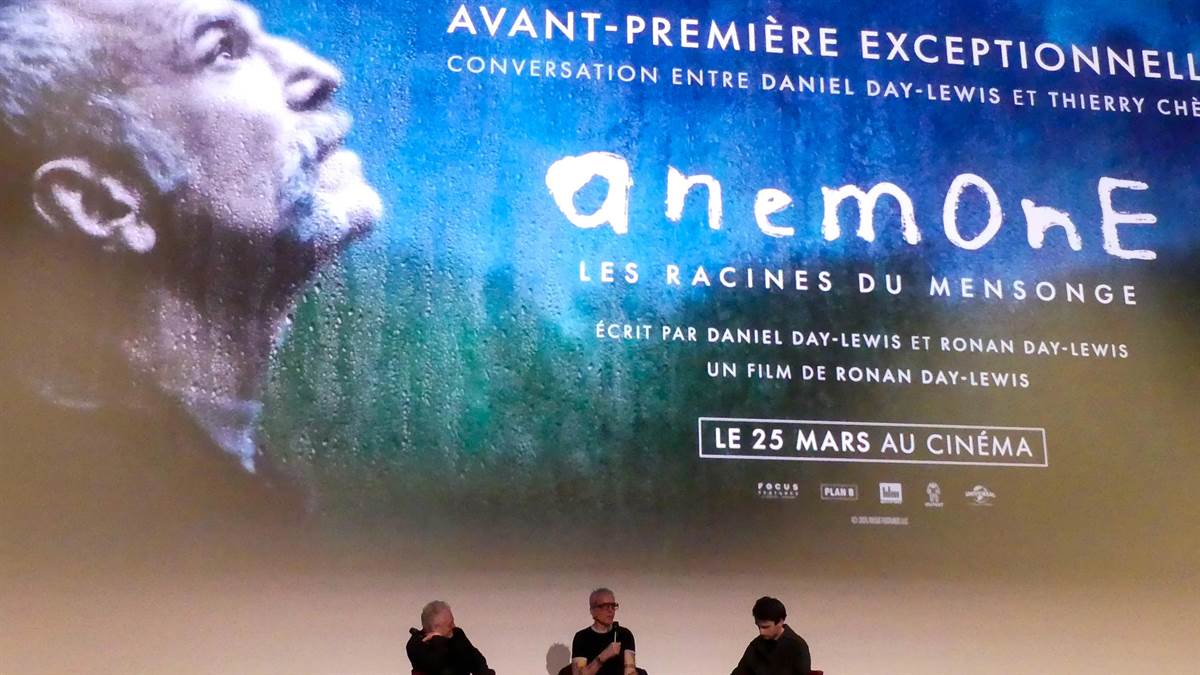
There are premieres, and then there are evenings that feel destined to become part of film lore. The Paris premiere of Anemone unquestionably belonged to the latter category, largely due to the extraordinarily rare sight of Daniel Day-Lewis walking a red carpet, an event that until recently seemed almost unimaginable following his retirement after Phantom Thread. Hosted at the elegant Pathé Palace on February 23, 2026, the evening unfolded with a palpable sense of anticipation. Inside the auditorium, once the credits rolled, the atmosphere shifted dramatically. A hushed, almost reverential silence settled over the audience, the kind that signals not mere appreciation but absorption. Industry professionals, critics, and devoted cinephiles shared that collective stillness before applause finally broke the spell.
Rather than a conventional promotional Q&A, the post-screening discussion evolved into something far more intimate and reflective. Daniel Day-Lewis, seated alongside French journalist Thierry Chèze, spoke with striking openness about the film’s origins, his decision to return to acting, and the creative partnership with his son, Ronan Day-Lewis, who makes his feature directorial debut with Anemone. The conversation centered less on career narrative and more on artistic trust, vulnerability, and the deeply resonant dynamic of being directed by one’s own child. Day-Lewis emphasized that the project never felt like a comeback in the traditional sense, but rather an organic response to a collaboration rooted in personal meaning and creative necessity.
Anemone first drew global attention when it premiered as the opening film of the New York Film Festival on September 28, 2025. A limited U.S. release followed on October 3 via Focus Features before expanding nationwide on October 10, with international distribution handled by Universal Pictures. The film quickly became one of the most discussed titles of the fall festival circuit, marking Day-Lewis’s return after an eight-year absence while introducing Ronan Day-Lewis as a confident and stylistically assured new voice behind the camera.
Co-written by father and son, the screenplay follows Ray Stoker, a man living in voluntary isolation deep within an English forest whose fragile equilibrium is disrupted by the unexpected reappearance of family and long-buried trauma. Themes of memory, emotional fracture, guilt, and reconstruction permeate the narrative, delivered through an elliptical structure critics have described as psychologically layered, occasionally opaque, yet consistently compelling.
Production anecdotes provided a grounded counterpoint to the mythology often attached to Day-Lewis. Principal photography began on October 1, 2024, in Manchester, with crew members noting the calm and focused energy on set. During location shooting in Handbridge, Chester, several vintage prop vehicles were ticketed for parking on double yellow lines. Local authorities later clarified that permits covered only technical vehicles and that broader road closure requests had been denied to minimize community disruption.
On screen, Day-Lewis delivers a performance of remarkable restraint. Eschewing grand gestures, he leans into silence, micro-expression, and subtle emotional modulation, crafting a portrayal defined by fragility and interior tension. Opposite him, Sean Bean channels unresolved intensity, while Samantha Morton provides emotional gravity and authenticity. Together, the trio generates a dramatic density that anchors the film even when the narrative drifts into abstraction.
Cinematographer Ben Fordesman envelops the story in a tactile visual language defined by natural light filtering through dense woodland, muted tonal palettes, and textured landscapes that function as psychological extensions of Ray’s fractured inner world. Composer Bobby Krlic constructs a score of spectral minimalism, where low-frequency unease and delicate ambient layers heighten sensations of isolation and vulnerability.
Produced by Dede Gardner and Jeremy Kleiner for Plan B Entertainment, Anemone benefits from cohesive contributions across departments, including costume design by Jane Petrie and production design by Chris Oddy, both reinforcing the film’s suspended, almost timeless atmosphere.
With its 126-minute runtime, Anemone occupies a space between character study and psychological meditation. The Paris premiere underscored what many sensed since its festival debut: this is not merely the return of a legendary actor, but the arrival of a filmmaker whose voice feels deliberate and mature. The audience’s attentive and visibly moved reaction reflected the awareness that the evening marked something uncommon: a cinematic legend rediscovering the screen, and a new director stepping forward with quiet authority.
Tags: anemone, daniel day lewis, ronan day lewis, paris premiere, film festival