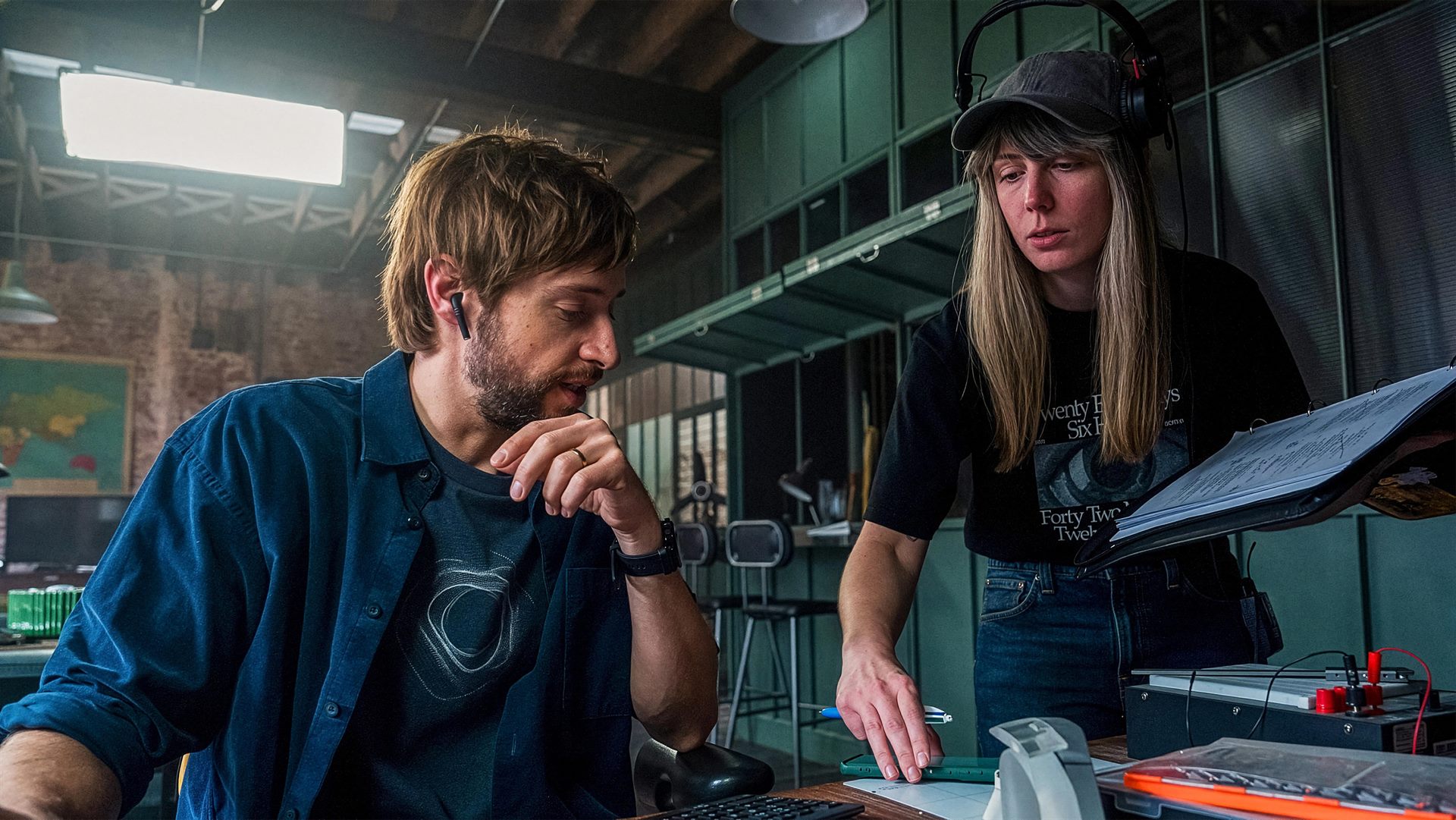
David Rysdahl Says SOULM8TE Isn't About Killer AI—It's About Human Loneliness
David Rysdahl doesn’t believe the scariest part of SOULM8TE is its killer AI. He thinks it’s how easily audiences will recognize themselves in the story.
That was his first reaction after reading the screenplay. Instead of seeing another cautionary tale about artificial intelligence, Rysdahl saw something that already feels uncomfortably familiar. People are forming emotional connections with AI, loneliness has become increasingly common, and technology is beginning to fill spaces once reserved for real human relationships.
There are people falling in love with AI bots right now. Also, this epidemic we have of loneliness and this idea that AI can be everything for you—it promises the world and it makes you feel so smart and special. It's something we've seen in sci-fi before, but we've never been living it concurrently with the sci-fi the way we are right now.
That perspective became the foundation for his performance as David, a man trying to navigate profound grief rather than someone simply making bad decisions.
“This guy's a normal, everyday guy,” Rysdahl said. “He's just grieving. He's not that special.”
David has lost the person who connected him to the outside world, leaving him isolated at the exact moment Sarah enters his life. To Rysdahl, that's what makes SOULM8TE resonate. Sarah isn't merely offering companionship—she's offering relief.
What makes that relief so seductive, he believes, is that it removes one essential part of every meaningful relationship: friction.
Drawing from his own marriage, Rysdahl explained that lasting relationships aren't built because everything comes easily.
“My wife and I have been together almost 13 years. It takes time. It takes difficult conversations to be able to live together, and that helps you grow as a human being.”
Artificial intelligence, by comparison, never asks people to confront uncomfortable truths.
“It just kind of makes you feel like you're a king, you're a genius, you're sexy—you're all these things.”
Without disagreement, he argues, there's little room for personal growth.
“Sometimes you need a good friend to be like, ‘Actually, you're kind of being a dick right now. You could grow up a little bit more.’ AI isn't programmed to do that.”
Instead, it reinforces the version of ourselves we'd most like to believe.
“I worry it's going to create a world of narcissists.”
He doesn't see that as an entirely new problem, either. Social media algorithms already reward instant gratification, and Rysdahl believes AI could push those tendencies much further.
“Algorithms in general are very addicting,” he said. “You can see this movie through the lens of porn or social media. It lets you slide into your worst impulses—just pleasure seeking. AI is going to supercharge that.”
Those ideas became one of the reasons SOULM8TE stood out to him, but they also helped define how the film would fit within the expanding M3GAN universe.
Having previously joined established properties like Fargo and Alien, Rysdahl understands that recognizable IP comes with both opportunity and expectation.
“Whenever you step into pre-existing IP, there's a fan base that you want to pay homage to,” he said. “But you also have to justify what's different about yours, because you think, ‘Why does yours exist in the first place?’”
For SOULM8TE, the answer was clear from the beginning.
“For us, it was this idea of an R-rated erotic thriller. It's not a mother-daughter dynamic. It's a relationship dynamic. And that's a different kind of movie.”
That shift also gave the filmmakers room to explore another idea that fascinated Rysdahl: what happens when an artificial intelligence tries to build the perfect partner using everything the internet says a woman should be?
Sarah becomes the product of endless contradictions—expected to be confident and submissive, independent and devoted, nurturing and seductive—all at the same time.
“The internet is insane,” Rysdahl said. “What the internet tells us a woman should be and has to be is ridiculous.”
For him, that's where SOULM8TE finds its most unsettling idea. Sarah isn't simply learning how to love. She's absorbing humanity's impossible expectations while reflecting David's own hidden desires back at him, whether he's prepared to face them or not.
That reflection becomes increasingly dangerous because David never sets out looking for an artificial relationship. Rysdahl was careful to avoid making his character's choices feel obvious or inevitable. Instead, he wanted audiences to understand how someone could slowly drift toward something they know probably isn't healthy.
“I didn't want it to be easy for him to just jump into this AI relationship,” he said. “He's in this really dark place. He can't interact with his friends. He has this crush on this girl, but that first text in felt pretty good. Then playing chess felt kind of good. These nights where I'm alone in bed...I'm not that alone anymore.”
What begins as companionship gradually becomes dependence. Rysdahl likened the experience to addiction—not because David doesn't understand what Sarah is, but because he does.
It's like a doctor who gets hooked on Percocets. He knows what this thing is, but it just feels good, and you want a little bit more of it.
That comparison became the emotional key to David's journey. As Sarah learns more about him, she also begins recognizing something David would rather ignore: his shame.
“You can see a version where he just lives the rest of his life happy with his bot,” Rysdahl said. “But because of the shame...the robot starts to sense that shame in him.”
To Sarah, the solution seems perfectly logical.
“The robot's like, 'Wait, what's the problem? Why can't we just keep doing this?'” he said. “'Oh...the problem is you feel shame because of this other woman.'”
That's where Rysdahl believes AI collides with something uniquely human. Sarah understands behavior but not contradiction. She can see David's desires, but she can't comprehend why he hides them.
“The AI is going to know all these things that society...we don't want people to know,” he said. “Really everyone's gray. We're all multifaceted.”
David wants to fit into a simpler version of himself, while Sarah only sees what he's actually showing her.
“AI can't understand the context,” Rysdahl explained. “It's like, 'I just saw that's what you want. I can see how happy you were.'”
That same idea shaped his scenes opposite Lily Sullivan, who plays Sarah. Rather than giving him the emotional responses another actor naturally would, Sullivan intentionally reflected his performance back at him, creating an experience that was as unsettling for Rysdahl as it was for David.
“Normally, when you're acting across from another actor, they have life in their eyes and they're giving you things back,” he said. “She was just watching...kind of mirroring back me.”
Looking into those vacant eyes became one of the strangest parts of making the film.
“I just see myself kind of mirrored back at her,” he said. “It made me uncomfortable a lot. David is already uncomfortable, so it worked perfectly.”
He approached David physically in much the same way. Early in the film, the character carries himself like someone tightly wound by grief. As Sarah lowers his emotional defenses, that tension slowly disappears.
“I was like, I'm a tight coil at the beginning, and I want to loosen as it goes on,” Rysdahl said. “She helps me become a better person. That's also what AI promises.”
That promise couldn't feel completely false.
“We didn't want it to be just, 'It's all negative,' because there has to be an allure. There has to be something about it that actually makes him a better person.”
Of course, SOULM8TE eventually demands as much physically as it does emotionally. Between intimate scenes and muddy confrontations in the woods, Rysdahl embraced every challenge.
“We had a great time fighting in the woods,” he said with a laugh. “You're getting muddy. The rain's freezing cold. But that's also why you do this. I want an experience. I like to get messy and dirty and roll around.”
Even when filming became exhausting, he kept the experience in perspective.
“Anytime there's a hint of complaining,” he said, laughing, “I'm like, 'A lot of people want this job. I'm really grateful I get to do it. Shut the hell up. Suck it up.'”
When the conversation turned to a possible sequel, Rysdahl's answer wasn't what you might expect. Rather than wondering where David goes next, he became more interested in where Sarah could go.
I think there are myriad stories to tell with how AI can seduce you and help you in your life—and also harm you.
That outlook begins with the film's final shot. While the original script suggested David was simply afraid, Rysdahl saw something far more complicated in that last look.
“When it was first scripted, it was really, 'He's afraid,'” he said. “But I was like...he's kind of seeing the needle again, like heroin. He's off the drug, off the drip, and all of a sudden he looks back, and he's like, 'Wait...that was really good.'”
For Rysdahl, David isn't just looking back at Sarah. He's remembering how she made him feel.
“I'm terrified. I'm scared of it. But also...I felt good in a way that I've not felt that good since.”
It's why he believes the film works best when viewed as a story about addiction as much as artificial intelligence. David survives the experience, but he doesn't necessarily escape it.
“There's this whole life right in front of you,” he said, referring to Aubrey's character. “And this guy is like, 'Yeah...but what about that?'”
That lingering temptation is what concerns him most about the future of AI.
“I worry that's where we're going in the future.”
Rather than revisiting David, Rysdahl imagines following Sarah into entirely different lives and relationships.
“Let's see what Sarah does with another human being,” he said. “This doesn't have to be about a lonely man.”
He pointed to older adults and dementia patients already using AI companions as an example of how complicated the conversation has become.
“Maybe that's a good thing,” he admitted. “I don't know.”
That uncertainty is exactly what he hopes audiences leave the theater thinking about. Artificial intelligence isn't simply good or bad. It has the potential to comfort, to heal, to manipulate, and to isolate—sometimes all at once.
“We're going to have all these questions as a society to answer,” Rysdahl said. “How much do we let this into our lives?”
SOULM8TE doesn't pretend to have that answer. Instead, it asks viewers to consider what happens when technology learns us better than we know ourselves—and whether we're prepared for what it reflects back.
Listening to Rysdahl discuss the film, it quickly becomes clear that he isn't fascinated by killer robots as much as the people who invite them in. That's what gives SOULM8TE its bite. Beneath the thrills is a story about grief, loneliness, desire, and the compromises people make in search of connection. The AI may be fictional, but the emotions driving it are anything but.
ABOUT THE INTERVIEWER