
FlickVision Interview
Unveiling Isle Of Hope: Romay's Revealing Look At His Latest Film
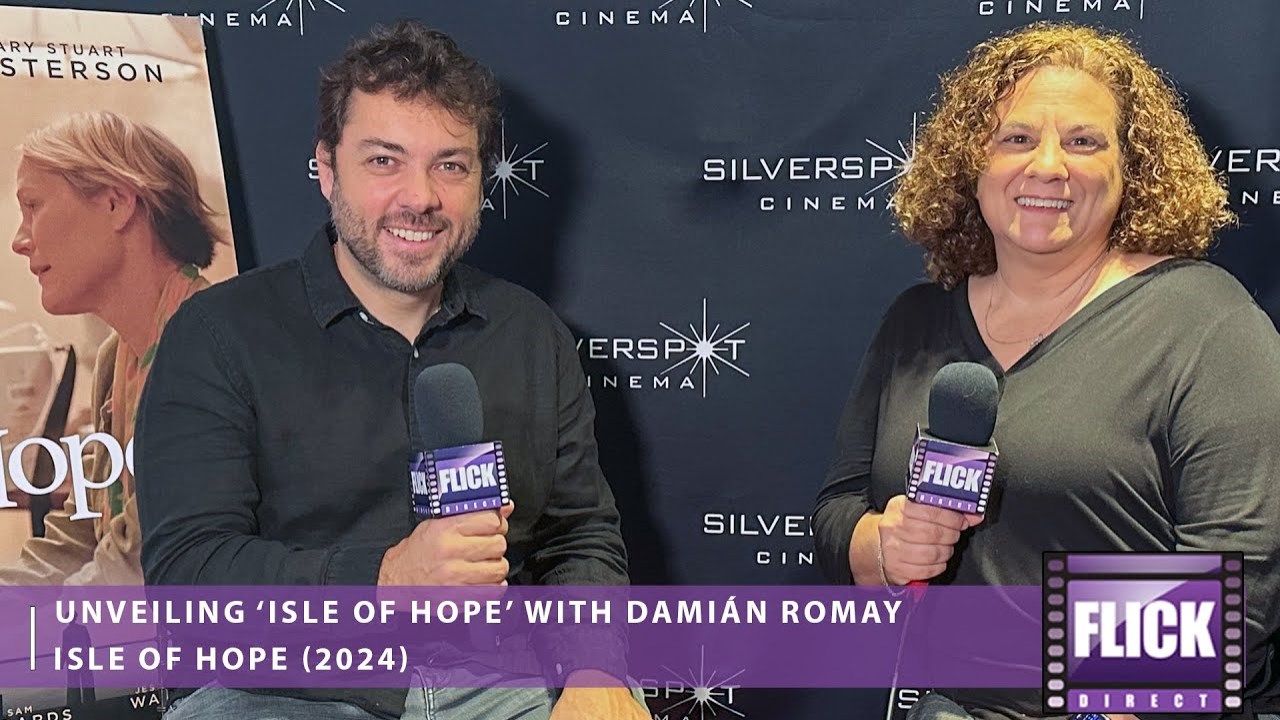
Dive deep into the world of 'Isle of Hope' with Director Damián Romay in a captivating FlickDirect sit-down at Silverspot Cinema, Coconut Creek, FL. Romay unveils the essence of choosing Savannah as the backdrop, enriching the film with its enchanting vistas and historical depth. The interview reveals the synergy of a star-studded cast, including Diane Ladd, Mary Stuart Masterson, and Andrew McCarthy, shaping the narrative's core. Romay discusses the indie filmmaking journey, the adaptation process from play to screen, and the personal growth encountered through this cinematic venture. Explore how 'Isle of Hope' mirrors themes of family, tradition, and the unspoken, set against the picturesque Isle of Hope, and how it promises to resonate with audiences through its authentic storytelling and character-driven plot.
Interview chapters
- 00:00:00 — The Isle of Hope Interview With
- 00:00:45 — Filming Isle of Hope Interview with Damián Romay
- 00:01:44 — Casting the Right Actors
- 00:02:50 — Collaborating with Great Directors and Actors
- 00:03:59 — The Experience of Making a Feature Film
- 00:05:16 — The Creative Process and Letting Characters Speak
- 00:06:37 — Praise for the Script and Film
- 00:07:35 — Flexibility and Openness in Filmmaking
- 00:08:47 — Open Communication and Regretting Unspoken Words
Read transcript
This was shot in Savannah, Georgia. Why was that location the right place? What did it bring to the feel of the movie? Savannah is a magical place. I mean, if you've ever been. Everywhere you point the camera, it's a movie. I mean, everywhere looks beautiful and haunted and enchanting. It's just an amazing city. And Diane, who we had cast as the lead, she's very southern.
You know, in her mannerisms and her way of speaking. And I thought, you know, a southern, you know, small city like Savannah, you know, would fit her perfectly and would fit the story perfectly of, you know, family and tradition. So I thought, oh, that was great. And plus we found, you know, Isle of Hope, which is just eight miles away from Savannah.
I was going to say, it's a real place. Why not shoot there? No, so we did. We shot a lot of the movie in Isle of Hope, which is kind of a suburb of Savannah, where a lot of people went to escape the plague in the early 19th century. And it has so much history. And I think all that history, you can kind of feel it when you're there. Yeah, Savannah is a wonderful city and it did fit beautifully with the film.
Speaking of the cast, Diane Ladd, Mary Stuart Masterson, Andrew McCarthy, not Sam Robard, Jason Robard, what did they bring to the film? Because I don't think this would have been the same movie had you cast other actors. Yeah. You know, I think casting is 90% of the movie is getting the right cast for the movie, I think. Or 90% of directing, they say, is just casting the right actors, right?
And they were just amazing people. I mean, not just great actors, but just great storytellers and creative people. They're so smart. All of them are writers, directors, producers, all three of them. Super talented, super successful. I remembered them from growing up watching their movies, Mary Stuart and Andrew. I'm a child of the '80s. Me too. The Brad Pack movies, John Hughes, and then all the stuff Mary Stuart Masterson did was just great.
And so I was in awe of them and so happy that I got a chance to really work with them and meet them. It's hard sometimes for an actor to take a chance and a director who hasn't done a theatrical feature and a very indie movie that's not a studio film. And they're taking a risk. They don't know what they're going to face once they arrive. And they all took that leap of faith in me.
And they all were so generous, sharing their ideas and their visions and their stories, working with other great directors and other great films. The whole experience was amazing. And Diane, well, I can't say enough good things about her. I mean, she's a brilliant actress, three times nominated for Academy Award. And I wish she would have got the nomination for this one because she's just so brilliant.
She, you know, 10-page scenes. She knew them like this, memorized them, had more energy than anybody else in the crew, almost in her 90s now. And her mind is-- works at a million miles per hour. We spent the summer together this last summer writing a movie together. And we just have so much fun together. She's so great. So great. I love the scene where she comes out of this amnesia.
And she just walks into the hospital room to her daughter and is like, don't you love it? And I mean, that's just so classic, old kind of Hollywood in her. She's so fun. She's so much fun. And she made up a little song and dance, you know, that she was doing. She's just wonderful. You mentioned that you really haven't done a big feature film before.
So what was this experience like? How was it different from working in a TV film? The way we shot it was very similar in the sense that it was a small production. I worked with a lot of the same crew that I usually work with. The main difference, I think, might have been maybe the actors were a little bit more recognized. But we still-- it was a movie that we shot in three weeks with a super tight budget, which is very similar to what I usually do.
I think I had more creative freedom than I usually have. A lot of the movies I usually do follow a formula and there's certain expectations from the audience. In this one, I had a little bit more free rein. It was just about telling the story the best way and just trying to communicate to the audience. And so in that sense, it was very rewarding. Wonderful.
Now, I know the film-- I'm sorry, the play does not include the ending part and doesn't really include about the granddaughter, so to speak, which I don't want to give away that part of it. But how did you get to that point when you were adapting the play and thinking, oh, this needs more? Where did that all come from? I think, I mean, at that point, after adapting the first part of the play, the characters started speaking to me and they wanted to complete the story.
And I wanted to let them keep going and see where that would take us. So the characters were so well created, they were so well thought out. And so I just let them resolve their issues. Plus, I think it's-- I wanted to get the satisfaction of seeing how all of that concluded. And so I just let them speak. I was kind of a stenographer, just writing down whatever they were saying.
And I enjoyed that part a lot, that process. Also, I had more freedom as well because I wasn't tied to the play. The whole time, I was afraid of doing-- I didn't want to disappoint Oscar Martinez, who I also admire greatly. And I didn't want to do something that he wouldn't like. And I was so concerned about that. And he loved the script and he loved the movie.
He had very high praise of it. And I'm so thankful for it because, as a writer myself, I don't want to destroy somebody else's work. It's a very tricky line, absolutely. So now that you've done all of this, what have you learned about yourself as a writer/director and personally, in your personal life? What did you learn from making this? That's a good question.
I haven't really-- [LAUGHTER] --put a lot of-- Haven't dissected it yet? I haven't put a lot of thought into it. But I think I learned a lot about-- just technically as a director, about working with actors, about listening to actors. And I've worked with a lot of actors. But again, maybe not of the same prestige as these actors. But I learned a lot about collaboration and also being flexible and open to the moment.
The movie, we shot it right in the middle of COVID. And the first day we were supposed to shoot, Mary Stuart Masterson tested positive for COVID. So my dad was still sleeping in the room. I had to redo the whole schedule, call Diane quickly not to travel to Savannah. She was getting on a plane. I said, don't get on the plane. We had to redo all the locations.
And I changed a lot of the plan that we had. And I think that flexibility is very important when you're working, especially in a small production like this. And I learned that sometimes it's for the best. Everything that happens is for the best if you can learn from it. And I learned to roll from it. So it was great. Even your failures are a success if you learn from them.
Absolutely. Has this changed your relationship with your own children? With my children? My children are pretty young. And I'm very close to them. But I try to be very close and to have very open communication with them. I think it's important not to leave things unsaid. And I think that's what the movie talks about. It's about all these things that we never talk about and we never say until it's maybe too late.
And this movie gives the character of Victoria, played by Mary Stuart Masterson, gives her an opportunity to say a lot of the things that she didn't say and look back at her life. When Carmen, Diane's character, wakes up thinking it's 15 years in the past. So she gets another chance at that relationship, which is great. I think it also gives her a chance to see her mother's decisions that she didn't see previously in a new light because it affected her own life.
So I think that was absolutely wonderful. I think the film is phenomenal. Like I said, it could have gone on longer, even with the ending the way it was. But I think so many people will learn from this. It'll resonate for so many people, especially those that have lost loved ones that regret not saying certain things. So thank you so much for your time, for the film, for everything.
And I can't wait to see how audiences react to it. Thank you. Thank you. And please go watch it. It's a small movie. We made it with a lot of love and I think you'll enjoy it a lot. So thank you so much. There you go, Asher.
More Interviews

ABOUT THE INTERVIEWER
ABOUT ISLE OF HOPE
Isle of Hope is the story of family and the complexities that come along with them. University Professor Victoria (Mary Stuart Masterson) has a grudge against her self-absorbed mother, the well-known actress Carmen Crawford (Diane Ladd), for crushing her dreams of becoming a playwright. When Carmen suffers a life-threatening stroke and wakes up from a coma, thinking she is living 15 years in the past, Victoria is given a unique opportunity to figure out where her life went off track and reconcile the relationship with her mother. Rounding out the cast is Sam Robards as Victoria's brother William, Andrew McCarthy as Victoria's ex-husband, and newcomer Jessica Lynn Wallace as their daughter.
Isle of Hope was adapted from an Argentinian stage play “Dias Contados” by Oscar Martinez and brought to the screen by writer/director Damian Romay. The Argentinean American film and television writer, producer, and director graduated from the University of Southern California's film school with a master's degree in screenwriting. Romay has made more than 30 films, several of which were filmed in South Florida, St. Petersburg, and Saint Augustine and have been seen on both television and streaming channels.
Directed By: Damián Romay
MPAA Rating: NR
Genre: Drama
Running Time: 96 minutes
Distributed By: Aventura Entertainment
Isle of Hope is © Aventura Entertainment. All Rights Reserved.