
FlickVision Interview
David Oyelowo on 'Lawmen: Bass Reeves' Exclusive SAG Event Interview
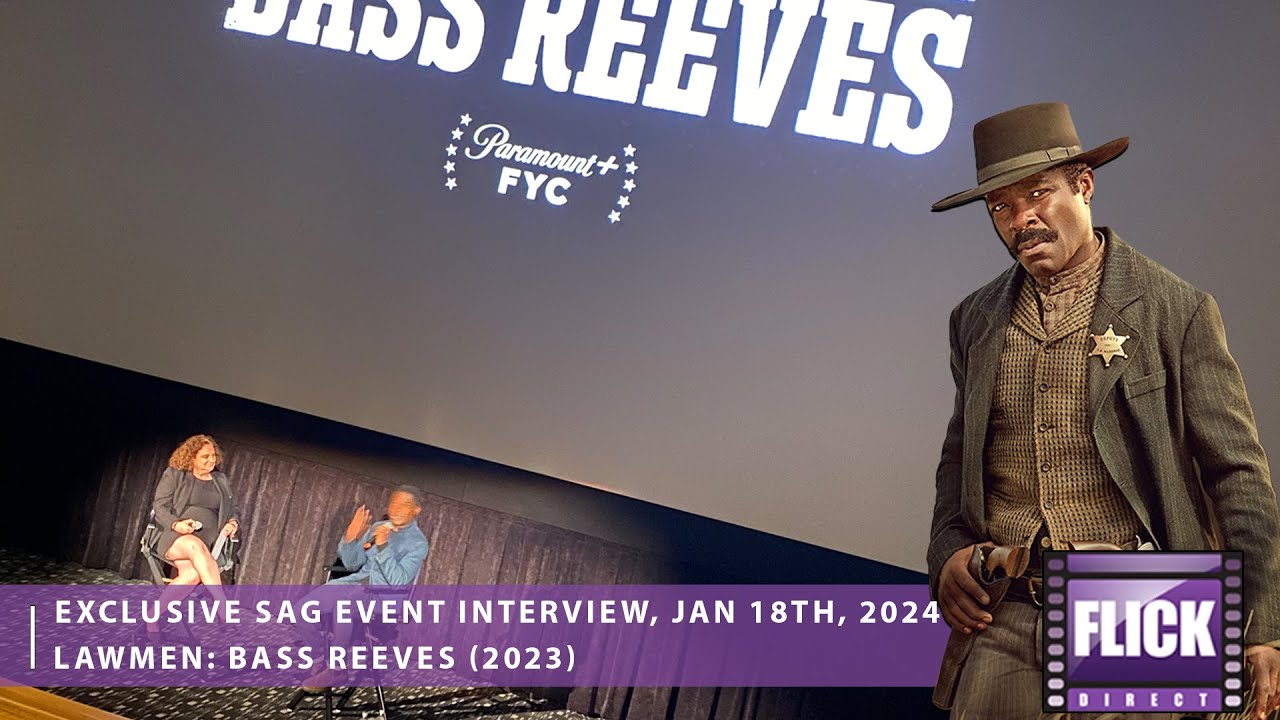
Join Allison Rose of FlickDirect in an exclusive interview with David Oyelowo about the making of "Lawmen: Bass Reeves." Apart from moderating a Q&A session at the SAG event, Allison delves into a personal interview exploring Oyelowo's deep connection with Bass Reeves' character. Discover the challenges and triumphs behind Oyelowo's portrayal of the legendary lawman, his insights on the cultural impact of the series, and the actor's journey from learning horse riding to mastering the Choctaw language. Get a unique behind-the-scenes look at this powerful historical series and the dedication involved in its creation.
Interview chapters
- 00:00:00 — Discovering Bass Reeves
- 00:01:44 — The Journey of Bass Reeves: From Enslavement to Empowerment
- 00:03:11 — Becoming Bas Reeves: Learning Horse Riding Skills
- 00:04:36 — Preparing for a Role in Texas with Challenging Weather
- 00:05:54 — Preserving the Choctaw Culture
- 00:07:25 — The Value of Telling Black Stories at Scale
- 00:09:02 — The Notoriety of Yellowstone and the Western Genre
- 00:12:07 — A Quiet Life
Read transcript
Hi, I'm Alison with FlickDirect and I'm here with David Oyelowo to talk about Law Men, Bass Reeves. Let's talk about Bass Reeves. How did you first hear about him and what were your first thoughts? I first heard about him in 2014. A producer by the name of David Permit approached me with the idea of doing some kind of screen version of this and after a very short amount of research online about him I just couldn't believe that there wasn't already a film, a TV show, a myriad of them actually by the way, because his life just seemed so extraordinary fantastical.
It felt like a story that almost wrote itself and so I as someone who had loved westerns growing up, as someone who is always looking for ways to exhibit black people in a way that I feel is commensurate with how powerful and essential they are not only in storytelling but in the world, this was just a home run for me and so the obsession with getting the story told started then.
So it's been 10 years for you making this journey. Yeah, yeah, yeah. Oh, I guess it has been. Let's talk about Bass because he was born into slavery and then ran and became a deputy U.S. marshal, the first black deputy U.S. marshal in the Indian territories. 32 years, barely ever injured which is pretty remarkable. So what aspect of his story do you feel is most important for people to understand?
Well that's why you know with with Lomond Bass Reeves we focused in on a period of his life as opposed to the totality because to be perfectly honest even eight episodes is by no means enough to really do it justice. As you say, born into enslavement, escaped enslavement, spent a number of years with Native Americans where he learned the skills that went on to be applicable as a deputy U.S.
marshal but then was a farmer for a time, a failed farmer. I think had a total of 10 kids. I think it was 11 and one of them passed away but then a 32-year career in law enforcement, 3,000 arrests and not only that but the Indian territory was deemed to be the most dangerous part of America at that time. The mortality rate for deputy U.S. marshals was incredibly high.
It mathematically makes no sense that he did it for as long as he did. So when you factor all of that in with that breadth of time as part of the equation, what we chose to do is to start with just the end of his enslavement, going into the civil war, him escaping and then the period that he then goes into to being a deputy U.S. marshal because it's where he goes from being enslaved to empowered and I think that is really the most inspiring, if you like, portion of his life and the thing that I think is most kind of amazing about him.
Absolutely. I agree it was very empowering to watch this man fear for his life and then become well-known, really, throughout the territory. For you as an actor, what skills did you have to learn? How difficult were they to learn? What came naturally to you to play Reeves? Well, you can't play someone like Bas Reeves and not know your way around a horse.
So, you know, I had ridden horses before but nowhere near to the degree that I was going to have to for this. So it was a year of horse riding that I had to put in several times a week, several hours on any given day, just to get to the point where it just felt and looked completely natural. I remember seeing Kevin Costner in Dances with Wolves and just being so blown away by his ability in terms of the skills he had to have for that film and that was, and even though I had seen that film way before I even knew anything about Bas Reeves, even before I wanted to be an actor, if I'm honest, but it stuck with me as something that was impactful in relation to watching that character.
So I knew that's something I had to master. It was a grueling shoot, six months. In Texas. In Texas, in Clement weather, I mean crazy, crazy weather and it's just one of those ones where I'm in almost every scene so you cannot get injured. So I spent a lot of time getting physically strong enough. And then there's the accent, as you can tell, I don't sound like someone from Oklahoma or Texas.
And so there was a fair bit of work had to go into that as well, but that's all the stuff I love as an actor. I really relish that stuff. And when you were learning some of the Choctaw language, how difficult was that to do? And what did you learn about yourself while you were learning that language? Oh gosh, good question. The Choctaw, the stakes around that became way higher than I anticipated when I first read it because the lady who was teaching me Choctaw, which is very, very difficult for me, you know, it's different when it's French or it's Spanish or it's German or it's a language that you kind of have a frame of reference for the sounds of Choctaw.
It's just not a language I've been around and most people haven't been around. In fact, the reason why the stakes felt so high is that there are only about 300 speakers of it left. They actually lost a lot of them during COVID, which is really distressing to hear. So the need to get it right, the need to be really respectful in terms of it being in the show in a way that hopefully for those who have Choctaw as their culture, as something they want to preserve, we are also saying that it is something that is important to the culture by having it in the show.
And what I learned about myself is how much I can feel the fear and do it anyway because when I found that out about how few speakers there are left, a language that was incredibly difficult to learn, I just went all out to try and make sure I got it right. Incredible. I was impressed, but I don't know Choctaw language, so it doesn't say much. Well, I'm glad you bought it even so.
I did, yes. As executive producer wearing that hat, were there times where you felt conflicted in terms of what was being put on the screen and what you wanted to see happen? There's always compromises to make when you're making a show, when hundreds of people are involved in the endeavor, when art is subjective, what is moving to one person is not necessarily the same for another.
But I will say that there is a decent amount of what I hoped the show would be that is on the screen because to be honest, in the years of rejection and struggle and challenge to get the show made, it had never really felt like we were going to get to tell it at this scale. Whether it's films like Selma or A United Kingdom or Queen of Cartway, several other films I have done that have centered black people sometimes in a period setting that should really warrant tens of millions of dollars.
We've had to do it for far less. They're just not as valued, these stories, unfortunately. But I have to say this probably the first time in my career where I've been part of producing a story where it has been given the kind of budget that the story warrants. And so a good deal of what one would hope the Bass Reaves story would be is up on the screen.
Fantastic. I know that Taylor Sheridan is involved with this. And at one point, this was going to be either a spinoff or a part of Yellowstone production. What about that would have changed the narrative? Yeah, it was never going to be a spinoff of Yellowstone. That was some clever executive at a studio somewhere doing a piece of marketing. But I get it.
That's a beloved show. And I think that certainly got people's attention. But for me personally, Bass Reaves story doesn't need to be an addendum or an offshoot of a very, very different story. And so I heard that along with the rest of the world and we fixed it pretty quickly. So it was never going to be that. Certainly not for me. But I will say that what the notoriety of Yellowstone and all of those shows that have come out of the Taylor Sheridan camp gave us were proof points of the fact that there is an audience, that the western isn't dead, that this history still resonates enormously, and that it is global.
And so to get to ride the coattails of that with this story was very significant. And you mentioned global. We had spoken off screen about people saying this doesn't have a global reach. What do you say to them now? Well, I mean, the show has gone on to be the most watched show globally on Paramount Plus in the last 12 months. So I think that speaks for itself.
I always felt that this would be, should be global. And the fact that it now has proven to be is great. But I feel like we've done this a number of times now as black people, whether it's will a black superhero be embraced, and then you see what Black Panther did. I did a film called The Butler, which we couldn't get financing for, and then it went on to make $170 million, and all things that people certainly didn't anticipate.
So I don't know how many times one has to prove that black and brown people are actually the global majority, and that the combination of that and streaming being a digital distribution that is truly global means that you no longer have the same degree of barrier of entry for audiences. And so even more so now than 10, 20 years ago, stories like this are actually the stories that are global as opposed to the ones that we keep getting force fed.
Very quickly, as we wrap up, he was born 200 years ago. If he had been born 50 years ago, knowing what he did with his life 200 years ago and his circumstances of his birth, what do you think he would be today? Wow. What would Bass Reeves be today? Would he be a leader? Would he be an outlaw? You know what? I think he... I don't know that he would be a leader.
I think he would be probably in law enforcement somewhere doing it incredibly well. He's someone who I don't think went out of his way to be a pioneer. He's someone I don't think went out of his way to be the first. He actually wanted a quiet life. He was quite happy being a farmer. He had these skills that he didn't particularly love in terms of being a marksman.
And he didn't go into politics. He wasn't out there being an activist either. He actually was quite quiet with the way he did things. He just really believed in justice. And I think he was one of those for such a time as this people whereby he was just born right place, right time. If he were born 10 years earlier, he probably would have aged out of being a deputy US marshal because he was going into that in his 30s.
And that's a physically incredibly demanding thing. But he happened to be the right age at the right time when this very small window of time, that is reconstruction, these 10 to 12 years where black people were given agency and empowerment between the Civil War and Jim Crow. So, you know, I just think he was born at the right time in order to go on to do what he did.
Well, I love his story. I love your portrayal. Thank you so much for bringing this to the world. Thanks, Alison. It was a pleasure. [Music] [ Silence ]
More Interviews

ABOUT THE INTERVIEWER

ABOUT LAWMEN: BASS REEVES
Revealing the untold story of the most legendary lawman in the Old West, LAWMEN: BASS REEVES follows the journey of Reeves (Oyelowo) and his rise from enslavement to law enforcement as one of the first Black U.S. Deputy Marshals west of the Mississippi. Despite arresting over 3,000 outlaws during the course of his career, the weight of the badge was heavy, and he wrestled with its moral and spiritual cost to his beloved family.
Directed By:
MPAA Rating: TV-MA
Genre: TV/Streaming Series
Distributed By: MTV Entertainment Studios


Lawmen: Bass Reeves is © MTV Entertainment Studios. All Rights Reserved.