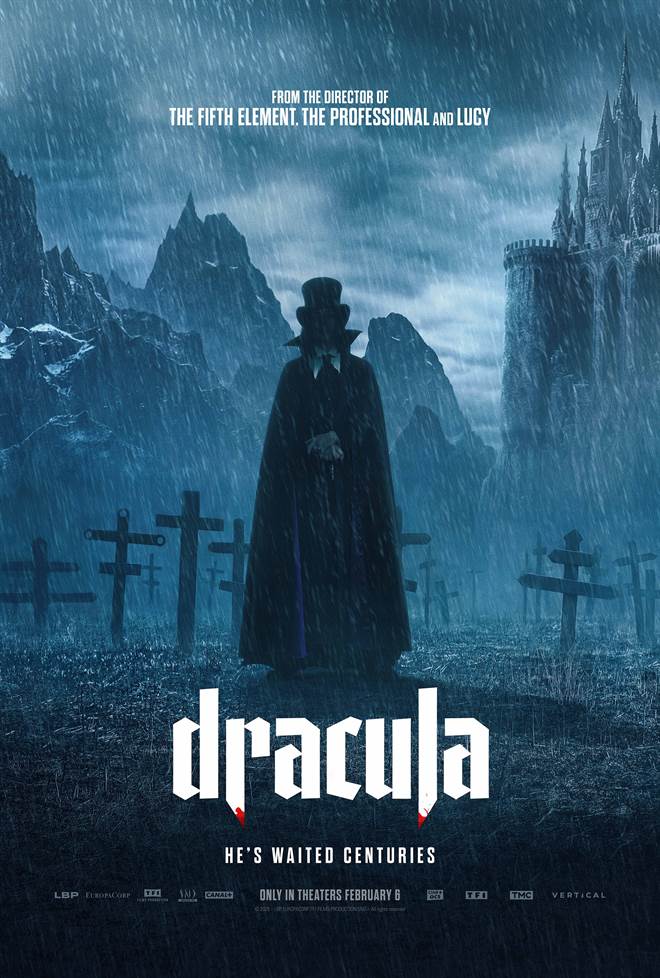
Luc Besson delivers a darker, more violent vision of the legendary vampire tale
Over the past hundred years or so, there have been numerous adaptations of Bram Stoker's novel Dracula, and the titular character has taken on various forms and iterations. He has also been called by different names, from Dracula to Nosferatu, and has been portrayed by such talented actors as Bela Lugosi (Island of Lost Souls) and Gary Oldman (Forrest Gump). The newest version of this classic tale of a monster lurking in the darkness comes from famed director Luc Besson (Léon: The Professional) and stars Caleb Landry Jones (X-Men: First Class), Zoë Bleu (Signs of Love), and Christoph Waltz (Inglorious Basterds). It is currently in theaters nationwide.
In the 15th century, during a battle with the Ottomans, Elisabeta (Bleu), wife of Prince Vladimir (Jones) of Wallachia, was killed. In despair from his loss, the prince renounces God and becomes Dracula. He then spends the next few centuries looking for the reincarnation of Elisabeta, eventually creating vampires who become agents to assist Dracula in his search.
After four hundred years, he finds Elisabeta's reincarnation in Mina (Bleu), the fiancée of a solicitor who has come to barter a deal for some property Dracula owns. Dracula imprisons the solicitor and goes to Paris to find Mina. After bringing Mina back to his castle, Dracula tries to help her remember her former life until she finally does and begs him to change her so she can live by his side for all eternity. The solicitor, meanwhile, has escaped and enlisted the help of an occultist priest (Waltz) in an attempt to save Mina.
Luc Besson has always been known as a director who builds tension in his films, and Dracula is no exception. From the moment the prince heads to war and witnesses the death of his beloved to his final confrontation with the priest, there is a constant sense of drama and stress that adds to the darkness that pervades the movie. He also offers stunning visuals and a starkness that tends to be a contrast from other versions of the story.
Besson has assembled a wonderful cast, beginning with two-time Academy Award winner Waltz. He offers an air of calmness as he is surrounded by chaos, and his character seems to encompass a sense of practicality in a story with very little of it. Jones' performance encapsulates an anger that simmers just below the surface, and he portrays the prince as a man of mystery and elegance while barely hiding his violent side. Bleu portrays the princess/Mina as a timid woman who has an inner strength that one wouldn't suspect by looking at her. Her beauty is incredibly striking, with soft edges, and makes it easy to understand why the prince would be so enamored with her.
The story tries to stay somewhat true to the novel, and there are common elements between it and Francis Ford Coppola's 1992 version. However, while the latter was much more romanticized, this version is quite a bit more violent. While the 1992 film would probably be categorized as a romance with horror elements, this new one would definitely be more horror with romantic moments thrown in.
Both movies are very good, but depending on your preference, you may gravitate to the older film as opposed to this latest one. I personally think audience members should see the 1992 movie before seeing this one, as each will offer different insights into the characters and the story.
Regardless of whether you have seen older versions of Dracula or Nosferatu or if this is your first foray into this dark world, this version of the movie has a lot going for it and will give you the gist of the story with a bit of interpretation built in.
Grade: B-