
FlickVision Interview
Kubo And The Two Strings Seeks to Revive The 'Ancient' Art Of Stop Motion Animation
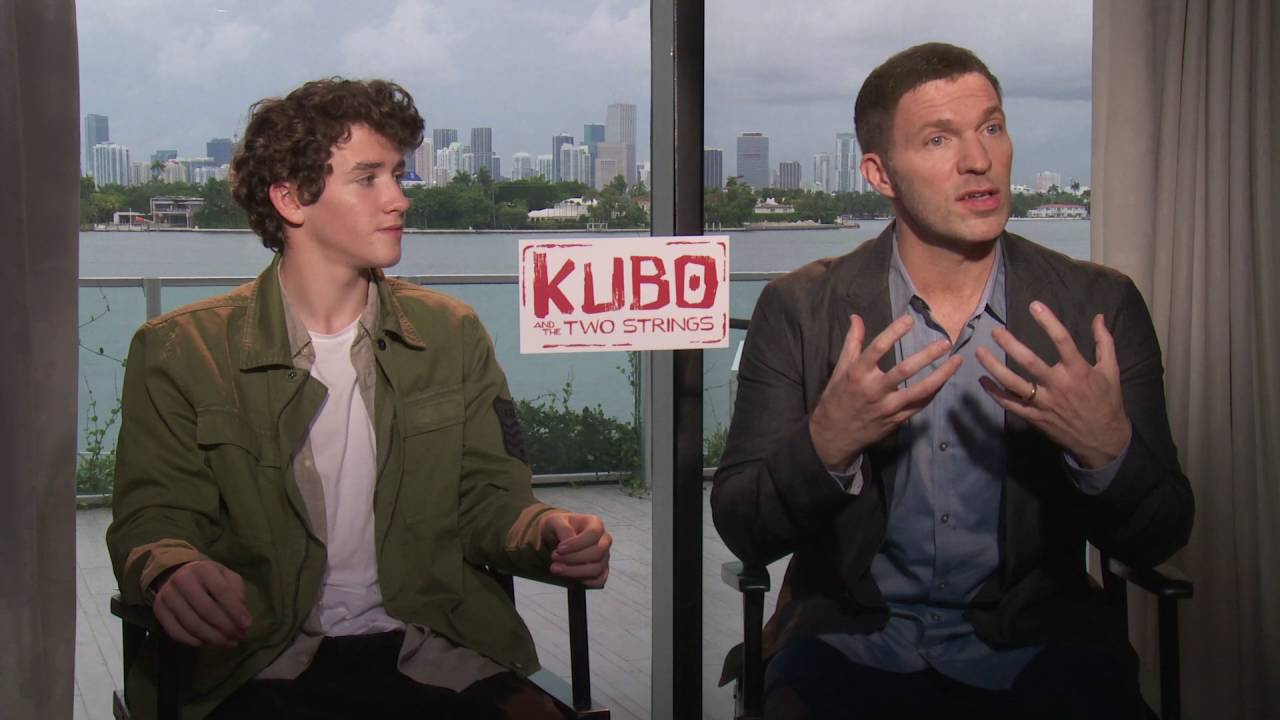
Join Alaina Rose as she sits down with Director Travis Knight and Art Parkinson, star of Kubo and the Two Strings, as they discuss stop motion in a world of computers, Japanese cultural influence in the film, and much more.
Interview chapters
- 00:00:00 — Kubo as a Storyteller
- 00:00:33 — Working with Leica and the Advancements in Stop Motion Animation
- 00:01:05 — Evolution of Stop Motion in Cinema
- 00:01:32 — The Future of Animation and Technology
- 00:01:58 — Technological Innovations in Filmmaking
- 00:02:23 — Accurate Portrayal of Japanese Culture
- 00:02:50 — Falling in Love with Japan
- 00:03:16 — Telling a period fantasy story
- 00:03:43 — Representing Irish Culture in Film
- 00:04:17 — Exciting Announcement on August 19th
Read transcript
What was your favorite part about the character Kubo? My favorite part about Kubo was the fact that he's a storyteller. And as an actor I like to think of myself as a storyteller and someone who brings characters to life through their emotion and their tone of voice and their different expressions. And Kubo does that with his origami and his shamisen.
So that's probably my favorite aspect of him. How is that different from the live action work that you've done? It's just sort of from the get-go it was trying to figure out how I can put all my emotion and take that and put it into my voice alone. And that's always tough. But working with Mum and working with Travis and the team at Laika, they made it very easy for me, especially because of the fact that there was you know puppets sort of set up and propped all over the room.
So that's really, it helps you to get into the mindset of the character and really provide an honest performance. Very nice, it seems like you enjoyed it a lot. Yeah. How have the advancements in stop-motion animation transformed the genre for you? Well in the ten years that we've been in existence at Laika, it's fundamentally changed every aspect of what we do.
Stop-motion is a technique that's been around for a century since cinema began effectively. And you know when, with the ascendancy of the computer in the 90s, when the computer could effectively be used as a tool to do everything that you could do in stop-motion and do it better and with greater flexibility, we had an inflection point where we had to figure, you know, what are we going to do?
How can we take this medium in a new place and justify our existence? What can we do with stop-motion that no other medium can do? And then when we started thinking about the different technologies that were taking place at the time, we thought what if we take this handcrafted art form that's been around for a hundred years and mix it with cutting-edge technology and forward-thinking innovation.
That was the beginning of Laika ten years ago, the convergence of all these different techniques. And it really has made, you know, propelled us forward. It started with Coraline where we started using 3D printing and rapid prototyping and digital capture systems and, you know, stereoscopic photography to bring that film to life. And with each film we built on all the technical and technological innovations on every movie so we could finally take on a movie like Kubo and his two strings, which is the biggest, most ambitious film that we've ever done.
It's this big sweeping fantasy epic. But because of the different elements that we've done in the last film, because of the different innovations that we've done on the last three films, it enabled us to do this so we can have these, you know, these massive monsters, these battles that take place on sea, and these incredible, beautiful, intimate performances between the characters.
Knowing that you have this affinity for Japanese culture, how important was it for you to portray that country accurately? It's incredibly important. I mean, anytime you're looking at something that's outside of your own experience, you have to make sure that you do your best to understand, that you do the research, that you look into the region, that you look into the history of the place.
My own introduction, my own personal introduction to Japan was about 35 years ago when I was 8 years old, and my dad took me there on one of his business trips. And, you know, I grew up on the west coast of America, so going to a place like Japan, it was unlike anything that I'd ever experienced before. And I just fell in love with the place, in every aspect to it.
I came home with a big backpack full of manga comic books, and I just poured through them. Even though I couldn't understand the language, there was just a power in the graphic and visual storytelling that really excited me as a visual artist, even as a kid. And so when you're telling a story that's, you know, it is a period fantasy, so it's a number of different things.
It's not a documentary. It's more of a kind of impressionist painting of a place. But at the same time, you want to make sure that your fairy tale has one foot in reality. And so we did tons and tons and tons of research to make sure that we're accurately capturing the reality of the place, so then we can fantasize it later in the film. How much research did you have to do?
As a very culture-oriented person, I'm an Irish speaker and I'm a Gaelic football player, and there are two very important aspects of Irish culture. So if I couldn't sort of accurately represent the culture, then I wouldn't have been able to bring this character to life. So it was very important for me to do a lot of research on the cabudos, the kimonos, the shamas, and every single aspect that was incorporated in the film.
And it wasn't just me, really. It was everybody at Leica, because, like, from the foliage to the dances in the film, everything is very, very culturally accurate. Well, congratulations, you two. Good luck with everything. Thank you very much. And the film is out August 19th. August 19th. Very nice. Tell everyone you know. And it's a story not to be missed. No. Thank you. [music] [Music]
More Interviews

ABOUT KUBO AND THE TWO STRINGS
Kubo and the Two Strings is an epic action-adventure set in a fantastical Japan from acclaimed animation studio LAIKA. Clever, kindhearted Kubo (voiced by Art Parkinson of “Game of Thrones”) ekes out a humble living, telling stories to the people of his seaside town including Hosato (George Takei), Akihiro (Cary-Hiroyuki Tagawa), and Kameyo (Academy Award nominee Brenda Vaccaro). But his relatively quiet existence is shattered when he accidentally summons a spirit from his past which storms down from the heavens to enforce an age-old vendetta. Now on the run, Kubo joins forces with Monkey (Academy Award winner Charlize Theron) and Beetle (Academy Award winner Matthew McConaughey), and sets out on a thrilling quest to save his family and solve the mystery of his fallen father, the greatest samurai warrior the world has ever known. With the help of his shamisen – a magical musical instrument – Kubo must battle gods and monsters, including the vengeful Moon King (Academy Award nominee Ralph Fiennes) and the evil twin Sisters (Academy Award nominee Rooney Mara), to unlock the secret of his legacy, reunite his family, and fulfill his heroic destiny.
Directed By: Travis Knight
MPAA Rating: PG
Genre: Family
Running Time: 101 minutes
Distributed By: Focus Features


Kubo and the Two Strings is © Focus Features. All Rights Reserved.